


A mantra is often described as a word, syllable or phrase that is repeated during meditation. That definition is not wrong, but it is far too small for what mantra practice has meant across thousands of years of spiritual tradition.
Why Mantras Deserve a Deeper Look
A mantra is often described as a word, syllable or phrase that is repeated during meditation. That definition is not wrong, but it is far too small for what mantra practice has meant across thousands of years of spiritual tradition.
In India, Tibet, Nepal and other parts of Asia, mantras have been used in prayer, ritual, meditation, initiation and contemplative practice for centuries. They have been spoken aloud, whispered, sung, repeated silently and transmitted through spiritual lineages. In some traditions, the sound itself is considered sacred. In others, the mantra is understood as a vehicle that can focus the mind, transform consciousness or orient the practitioner toward liberation.
How does a Mantra work?
If we want to understand how a mantra works, we have to avoid two equally weak positions. The first is to reduce mantra practice to a simplistic claim such as “it raises your vibration.” The second is to dismiss the entire practice as superstition because its deeper claims cannot yet be measured scientifically.
Neither approach is sufficient. Some aspects of mantra practice can be studied physiologically and psychologically. We can observe what happens to breathing, attention, autonomic regulation and brain activity. Other aspects belong to philosophy and spiritual experience. These include the idea that sound may have an intrinsic sacred quality, that certain mantras can alter consciousness in ways that exceed ordinary psychology, or that a mantra can ultimately contribute to liberation from the cycle of birth and death.
The most intellectually honest approach is therefore not to force everything into one category. We should distinguish clearly between what is known, what is plausible, what is traditional teaching and what remains an open metaphysical question.
That distinction does not weaken spirituality. It makes it more credible.
What is a MANTRA?
The word mantra comes from Sanskrit and is commonly associated with the idea of an instrument or vehicle of the mind. Popular explanations often derive it from man, related to thinking or mind, and tra, associated with a tool, instrument or means of protection.
Even that translation only takes us so far.
A mantra is not simply an affirmation. An affirmation usually depends mainly on semantic meaning. If someone repeats, “I am strong” or “I am worthy,” the psychological effect is closely tied to the content of the sentence.
Traditional mantras can work differently.
Some contain complete phrases or verses, but others consist of short syllables that cannot be translated in the ordinary sense. These are often referred to as bīja mantras, or seed mantras.
Examples include sounds such as Hrīm, Śrīm and Klīm.
The significance of such sounds lies not only in what they mean, but in how they are used, pronounced and experienced.
This points to one of the most important differences between ordinary language and sacred sound. In everyday speech, words represent things. The word “tree” refers to a tree, but the word itself is not the tree. In several Indian spiritual and philosophical traditions, however, sound is treated as more than a symbolic label. Sacred sound can be understood as participating in reality itself.
That is a much more radical idea.
The Body Hears a Mantra Before the Mind Understands It
Before we enter metaphysics, it is useful to begin with the body.
A spoken mantra immediately changes several physiological processes. The practitioner breathes differently, produces vibration through the vocal cords and regulates attention in a repeated rhythm.
Long chants naturally influence breathing patterns. If a phrase takes several seconds to pronounce, the exhalation is extended. This matters because slow breathing can influence the autonomic nervous system, particularly processes associated with parasympathetic regulation and relaxation.
This gives us an important insight.
A person does not have to understand the philosophy behind a mantra for the body to respond to chanting. The nervous system may react to rhythm, breathing and vocal vibration long before the conscious mind interprets the words.
This is one reason mantra practice cannot be reduced to belief alone.
Even if the practitioner does not know the literal meaning of the Sanskrit, chanting may still alter respiration, muscular tension and subjective arousal.
Breath as a Bridge Between Consciousness and the Nervous System
Breathing occupies a unique place in the human body because it functions both automatically and voluntarily.
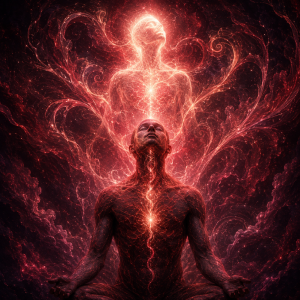
You do not normally have to think about breathing. Your body continues the process without conscious supervision. At the same time, you can deliberately slow the breath, hold it or lengthen the exhalation.
This makes respiration a bridge between conscious intention and autonomic physiology.
Mantra practice frequently works through that bridge.
A slow mantra can establish a breathing rhythm without the practitioner needing to count seconds or consciously regulate every inhalation and exhalation. The words themselves become the structure of the breath.
Over time, this can create a state in which breath, sound and attention become synchronized.
That synchronization may be one of the reasons many people experience chanting as calming or centering.
It is not necessary to explain this through mystical language. The physiology is already interesting enough.
Vibration Is Real, but That Does Not Mean Every Frequency Claim Is True
The human body physically vibrates during chanting.
If you sustain the sound “mmm,” you can feel the resonance in the lips, jaw, cheeks, throat and skull. Depending on pitch and vocal placement, vibration may also be felt in the chest.
This is not metaphorical. It is a physical event. And the body becomes part of the acoustic system.
However, this is also where some modern spiritual claims become exaggerated. It is common to hear that a particular mantra “vibrates at the frequency of the universe” or that certain fixed frequencies automatically heal specific organs or activate chakras.
These statements sound scientific because they use technical language, but many of them are not scientifically established.
A spoken mantra does not even have one single fixed frequency. Human speech contains fundamental tones, harmonics and complex resonances that constantly change. The same mantra spoken by different people will have different measurable acoustic properties.
This does not mean that vibration is irrelevant. It means that we should not confuse a real physical phenomenon with unsupported claims.
There is no need to weaken mantra practice by attaching false certainty to it.
Rhythm Changes the Experience of the Mind
Human beings are rhythmic organisms.
The heart beats rhythmically. Breathing follows cycles. Sleep and waking follow circadian patterns. Walking has rhythm. Speech has rhythm.
Chanting introduces another rhythm into this biological system.
When sound, breathing and attention become repetitive, the mind begins to organize itself around that repetition.
This is especially noticeable in group chanting. When several people chant together, their breathing patterns and vocal rhythms begin to align. The effect can feel powerful because the individual is no longer producing sound alone. A collective rhythm emerges.
There is nothing trivial about this.
Across cultures, human beings have used synchronized singing, drumming, movement and prayer in religious ceremonies, healing rituals and communal gatherings.
Rhythm reduces randomness. It organizes experience. A mantra does exactly that.
A Mantra Gives the Mind One Thing to Do
Anyone who has ever tried to sit quietly for several minutes knows how quickly the mind starts producing material.
Thoughts appear without invitation. Memories arise. Future conversations are rehearsed. Old arguments return. Worries generate new worries.
The mind does not wait for permission.
Mantra practice does not attempt to destroy thought by force. Instead, it introduces a repeated object of attention.
Whenever the mind wanders, the practitioner returns to the mantra.
This sounds simple, but it has profound consequences.
Each return represents a small act of attentional training. The mind moves away. The practitioner notices. The mantra is restored. This can happen hundreds of times in a single session.
Over weeks, months or years, that repeated act may strengthen the ability to notice when attention has been captured automatically. That ability is fundamental to meditation.
The Mantra Does Not Fight the Mind
One of the most common mistakes in meditation is trying to force the mind into silence.
A person sits down and thinks, “I must stop thinking.” That immediately creates another layer of thought. The practitioner begins monitoring the mind, becoming frustrated with every new thought and trying harder to suppress it. The result is often more mental tension.
A mantra uses a different strategy. It does not say, “Do not think.” It simply gives the mind somewhere else to return.
This is psychologically elegant because it replaces suppression with redirection. The thought appears, but the practitioner does not have to follow it. Attention returns to the sound. Over time, the ordinary stream of mental commentary may become less dominant. This does not mean thoughts disappear permanently. It means they lose some of their automatic authority.
The Sense of Self Can Become Quieter
Modern neuroscience has become increasingly interested in the brain systems involved in self-referential thinking. One of the best-known networks is the default mode network, which is involved in autobiographical thinking, men
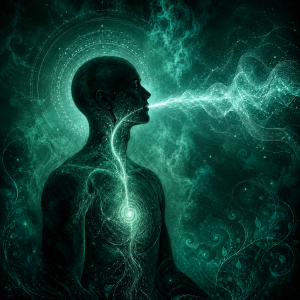
tal time travel and internal narratives about the self. When we replay the past, imagine the future or think continuously about who we are, this network is often active.
Spiritual traditions have questioned this constant narrative identification for thousands of years. Are we the story we tell about ourselves? Or are we the awareness in which that story appears?
Mantra practice can make this question experiential rather than theoretical. When attention is repeatedly absorbed in a sound, the usual narrative of “me” may temporarily weaken.
For a while, the mind is not endlessly occupied with biography. There is sound, breath and awareness.
This shift can create a sense of spaciousness or inner distance from the usual identity. Science can study aspects of the brain activity associated with such states, but the philosophical interpretation remains open.
Meaning Matters Too
Not every mantra is merely a neutral sound. Many carry profound meaning. If a person repeats a phrase about fear, mortality, surrender or liberation, the semantic content becomes part of the practice. Words activate associations. Associations activate memories and emotional responses. Repeated meaning can gradually shape the way a person interprets experience.
This is one reason the Mahamrityunjaya Mantra is so powerful. Its language does not simply ask for comfort. It addresses mortality, attachment and freedom. Every repetition therefore places the practitioner in contact with those themes.
The mantra becomes a form of philosophical contemplation embodied through sound.
Repetition Is One of the Main Ways Human Beings Are Conditioned
Repetition often appears boring because we associate it with routine. In reality, repetition is one of the most powerful mechanisms of learning. Language develops through repetition. Motor skills develop through repetition. Habits develop through repetition. Fear can be strengthened through repetition. Social conditioning depends heavily on repetition.
Much of what we call personality is partly built through repeated patterns that eventually become automatic.This raises a fascinating question.
If unconscious repetition can shape the mind, can deliberate repetition reshape it?
Mantra practice is essentially a structured form of conscious repetition. It introduces a chosen pattern into a system that is already full of automatic patterns.
That may be one of its deepest psychological functions.
When the Mantra Begins to Continue by Itself
Many contemplative traditions describe a stage in which the mantra no longer feels entirely deliberate. At first, the practitioner consciously repeats it. Later, the repetition can become so familiar that it seems to continue automatically. In Indian traditions, this is sometimes described as ajapa japa, the state in which repetition seems to occur without active effort.
Psychologically, this is not difficult to understand. Anything practiced thousands of times can become automatic. However, the subjective experience is still fascinating because it changes the relationship between the practitioner and the mantra.
At first, the experience is clearly:
“I am repeating the mantra.”
Later, it may become:
“The mantra is happening.”
That shift can lead to a deeper question. If the mantra is continuing without deliberate effort, who exactly is the doer?
The Mantra Can Become a Doorway Into Self-Inquiry
At a certain point, mantra meditation can move beyond concentration.
The practitioner may begin to notice the relationship between sound and awareness. The mantra appears in consciousness. The breath appears in consciousness. Thoughts appear in consciousness. Sensations appear in consciousness.
Then a new question arises.
What is it that knows all of this? The sound changes. The breath changes. Thoughts change. Emotions change.
Yet something seems to be present through all of those changes.
Indian philosophical traditions have explored this question in different ways, but many of them point toward a distinction between changing experience and the awareness in which experience appears.
This is where mantra practice can become more than a relaxation technique. It becomes a direct investigation into identity.
A Mantra May Eventually Lead Toward Silence
The deepest purpose of mantra practice may not be endless repetition. In many contemplative traditions, the mantra becomes progressively subtler. It may begin as loud chanting. Then it becomes whispered. Later it is repeated mentally.
Eventually, there may be periods in which even the internal repetition becomes quiet. The practitioner is left with silence. At that point, the mantra has done something paradoxical. Sound has led toward silence. This is one of the most beautiful aspects of the practice.
The mantra can be understood as a boat that carries the mind across a river. Once the crossing has taken place, the boat is no longer the destination. The silence that follows may become more important than the sound that came before it.
OM Is More Than a Relaxing Sound
Perhaps no mantra is more widely recognized than OM, or AUM. Unfortunately, popularity has also trivialized it. The symbol appears on jewellery, clothing and decorative objects around the world, yet its philosophical meaning is much deeper. In Indian traditions, AUM can represent the totality of consciousness.
The three audible elements are commonly associated with different states.
- The sound A is linked with waking consciousness.
- The sound U is associated with the dream state.
- The sound M is linked with deep sleep.
Then comes silence. That silence is not merely the absence of sound. In philosophical interpretations, it points toward a state beyond ordinary waking, dreaming and sleeping. The sound therefore becomes a map of consciousness. The mantra begins in experience and points beyond experience.
Sacred Sound and the Idea of Shabda Brahman
Some Indian philosophical traditions develop the role of sacred sound even further.
The concept of Shabda Brahman refers, in very broad terms, to the relationship between ultimate reality and sound or sacred word.
This does not simply mean that “everything is vibration,” as modern spiritual language often claims. However the traditional concept is more complex. It concerns the relationship between consciousness, language, manifestation and reality itself.
In this view, sound is not merely something that occurs inside an already existing universe. Sound may participate in the structure through which reality becomes knowable or manifest.
This is a metaphysical claim, not a scientific conclusion. Although science currently has no way to establish that a Sanskrit syllable has an intrinsic cosmic power. At the same time, science also does not possess a complete theory of consciousness or reality. The correct response is therefore neither certainty nor dismissal. The correct response is intellectual humility.
What Science Can and Cannot Say
Science can study measurable effects of mantra practice. It can investigate breathing patterns, heart rate, autonomic regulation, stress markers and brain activity. It can examine whether chanting improves attention, reduces anxiety or changes subjective wellbeing.
These are legitimate areas of research. What science cannot currently confirm is whether a mantra has an effect outside the practitioner in the metaphysical sense. It cannot establish that sacred syllables alter reality through an invisible vibrational field, and also it cannot prove that mantra repetition releases karma. There is no prove that chanting frees a person from rebirth. Those claims belong to religious and metaphysical traditions. That does not automatically make them false. It simply places them outside what current scientific methods can verify.
The Mahamrityunjaya Mantra
One of the clearest examples of the deeper purpose of mantra is the Mahamrityunjaya Mantra.
https://www.facebook.com/share/r/1EDsqhv7cC/?mibextid=wwXIfr

The mantra is ancient and appears in the Rigveda. It is addressed to Tryambaka, the Three-Eyed One, who later becomes strongly associated with Shiva.
The text is usually rendered as follows:
Om Tryambakam Yajamahe
Sugandhim Pushtivardhanam
Urvarukamiva Bandhanan
Mrityor Mukshiya Maamritat
It is often called a healing mantra.
That description is understandable, but incomplete. The mantra certainly has traditional associations with protection, vitality and healing. However, its deeper meaning points toward liberation from death itself. Not necessarily from one physical death, but from the entire condition of mortality.
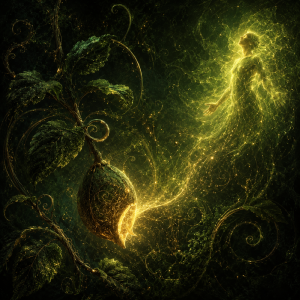
The Image of the Ripe Fruit
The most striking image in the mantra is the comparison with ripe fruit separating from its stem.
The wording evokes something that has reached maturity and is naturally released from its bond. This is a very different image from violent escape. The fruit does not hate the vine. It does not fight the stem. It simply reaches the point at which separation becomes natural.
That image contains an entire spiritual philosophy. Perhaps liberation does not come through forcing ourselves to detach from life. Perhaps it comes through ripening.
A person may need experience, suffering, love, loss, failure and insight before certain attachments become ready to fall away. The mantra does not necessarily ask for destruction of the world. It asks for release from bondage.
Death Is Not the Only Problem
In many Indian spiritual traditions, physical death is not the final problem.
The deeper problem is samsara. Samsara refers to the cycle of birth, death and rebirth. From this perspective, dying is not liberation. Death is followed by another birth, and the cycle continues.
The real goal is moksha. Moksha means liberation from the cycle itself.
This is where the Mahamrityunjaya Mantra becomes much more radical than a simple prayer for longevity. If death is part of an endless cycle, then conquering death cannot simply mean staying alive longer. True liberation would mean no longer being bound to the process that repeatedly produces birth and death.
Liberation From Death Is Not the Same as Avoiding Death
This distinction changes the entire interpretation. There are two very different prayers a human being can make. The first is: “Do not let me die.” The second is: “Free me from the condition that makes death a prison.”
The Mahamrityunjaya Mantra belongs far more deeply to the second category. Physical immortality is not the goal. The body will die. Every historical practitioner who has ever chanted this mantra eventually died.
If the mantra promised biological immortality, that promise would already have failed. The deeper possibility is that the mantra points toward an identity that is not limited to the body.
“Do Not Separate Me From Immortality”
The final words of the mantra are among its most profound. Mā amritāt is commonly understood as “not from immortality” or “not from the deathless.” This introduces a paradox. The practitioner asks to be released from death, but not from immortality.
The meaning cannot simply be that the body should survive forever. Instead, the phrase suggests a distinction between what dies and what is deathless. This is one of the central questions of Indian philosophy. What part of the human being is temporary? What part, if any, is permanent?
The body changes. The personality changes. Thoughts change. Emotions change. Even identity changes over a lifetime.
If everything changes, is there anything that does not?
The mantra directs attention toward that question.
The Three-Eyed One and the Problem of Perception
Tryambaka means the Three-Eyed One.
In later Shiva symbolism, the third eye represents a form of perception beyond ordinary sight. Two eyes see objects.
They see separation, difference and form. The third eye represents insight into what lies behind appearances. This symbolism fits the mantra perfectly.
- If the goal is liberation from mortality, then perhaps the problem is not death itself. Perhaps the problem is the way we perceive ourselves.
- If we believe that we are nothing more than a temporary body and biography, death becomes absolute.
- If consciousness is more than that, then the entire meaning of death changes.
The third eye symbolizes the possibility of seeing differently.
Avidya: When Ignorance Means Misidentification
Many Indian traditions describe ignorance, or avidya, as one of the roots of suffering. This does not mean ignorance in the ordinary sense of being uneducated. A person can be highly intelligent and still be spiritually ignorant. Avidya refers to a fundamental misperception.
- We mistake the temporary for the permanent.
- We mistake possessions for identity.
- We mistake thoughts for self.
- We mistake the body for the whole of what we are.
From this perspective, death is terrifying because it threatens everything with which we have identified.
If the body is me, then the death of the body means the end of me. Accordingly if my biography is me, then losing memory or social identity becomes existentially devastating. Spiritual practice questions this identification. It asks what remains when everything changeable is observed as changeable.
Mantra as Preparation for Death
Seen from this perspective, the Mahamrityunjaya Mantra can be understood as a preparation for death.mNot because it is morbid, but because it teaches release. Every repetition reminds the practitioner that attachment is temporary. The body will be lost. Relationships will change. Possessions will disappear. Youth will vanish. Identity itself will transform.
The question is whether we can learn to release consciously before life forces us to release. This is why the image of the ripe fruit is so powerful. The fruit does not collapse in terror. It releases when the time has come.
Mantra and the Cycle of Repetition
Samsara can be understood literally as repeated birth and death. It can also be understood psychologically. Human beings repeat themselves constantly.
- We recreate old relationships.
- We repeat the same fears.
- We choose familiar forms of suffering.
- We reenact childhood patterns.
- We repeat reactions long after the original danger has disappeared.
In this sense, samsara is visible within a single lifetime. We are repeatedly reborn into our own conditioning. A mantra can interrupt that cycle. Each time an automatic thought arises and attention returns to the mantra, a pattern is broken. The interruption may be small, but the principle is profound. Freedom begins where automatic repetition stops.
Karma Can Be Understood at More Than One Level
Traditional karma concerns cause and consequence across lifetimes. Whether one accepts that metaphysical framework is a matter of worldview. However, karma also has an obvious psychological dimension.
Actions create habits.
Habits shape character.
Character influences future choices.
Those choices produce new consequences.
The cycle continues.
A person who reacts with anger strengthens anger, and who repeatedly withdraws strengthens avoidance. Somebody who repeatedly returns to awareness strengthens another kind of response. This does not prove the metaphysical doctrine of karma. It shows that the basic principle of cause and consequence operates visibly within human psychology.
Mantra Can Create a Gap Between Trigger and Response
One of the most practical effects of contemplative training is the creation of a pause. Something happens. An emotion arises. Normally, reaction follows immediately and – with enough awareness – a gap can appear. The emotion is still there, but the practitioner notices it before acting.
That small gap can change a life. A person who has spent years training attention through mantra may become more capable of noticing impulses before following them. This is not mystical. It is one of the clearest ways in which practice can produce freedom. The external event remains the same. The internal reaction becomes less automatic.
The Question of Consciousness
Eventually every serious discussion about mantra reaches the same unresolved territory.
What is consciousness?
Neuroscience can observe correlations between brain activity and subjective states. It can study what happens when the brain is injured, sedated or stimulated. What it still cannot fully explain is why there is subjective experience at all.
- Why does pain feel like something?
- Why does colour appear as experience rather than merely electromagnetic information?
- Why is there an inner world?
This is one of the great unresolved questions of philosophy and neuroscience. Contemplative traditions approach the problem from the opposite direction. Instead of observing consciousness from outside, they investigate it directly through experience. Mantra is one of the tools used in that investigation.
Does the Brain Produce Consciousness?
Modern neuroscience generally assumes that consciousness depends deeply on brain function. That conclusion is well supported. Changes in the brain clearly alter experience. Anaesthesia can interrupt ordinary consciousness. Brain injury can transform personality. Drugs can change perception. The dependence is obvious.
The philosophical question is whether dependence proves production. Does the brain generate consciousness completely, or does it mediate something more fundamental? There is no final consensus. Some philosophers and scientists hold strongly materialist views. Others explore alternative models.
Spiritual traditions often assume that consciousness is more fundamental than the body. At present, none of these positions can claim absolute proof.
The Question of Reincarnation
If the Mahamrityunjaya Mantra is interpreted as a mantra of liberation from samsara, the question of reincarnation inevitably appears.
Is rebirth real? Religious traditions answer yes. Materialist worldviews generally answer no. Science has not established reincarnation as a proven fact. There have been investigations into unusual cases, including children who report apparent memories of previous lives, but these remain controversial and open to interpretation.
An educated spiritual position does not require blind certainty. It is possible to remain open without pretending that the question has been solved. That may be the most honest position.
Mantra Is Not a Substitute for Reality
Spiritual practice becomes dangerous when it is used to escape reality. A person may chant for healing while refusing necessary medical treatment. Someone may repeat mantras for peace while remaining in an abusive relationship. Another person may use spiritual language to avoid confronting trauma or anger. This is spiritual bypassing.
A practice that disconnects us from reality is not liberation. Authentic spiritual work should make perception clearer. It should increase the capacity to face uncomfortable facts. A mantra is a tool. It should not become a hiding place.
Mantra and Trauma Require Sensitivity
Not everyone experiences inward-focused practice as calming. For some people, silence can initially increase distress. Closing the eyes may feel unsafe. Internal sensations can trigger traumatic memories. This is why spiritual practices should not be applied mechanically. Some people may benefit more from chanting aloud with open eyes. Others may prefer walking, movement or group practice. The nervous system matters. Spiritual depth does not require ignoring biology.
Intention Changes the Practice
A mantra repeated mechanically while the mind is elsewhere is not the same as a mantra repeated with complete attention.
The sound may be identical, but the experience differs.
- Intention shapes attention.
- Attention shapes perception.
This is one reason traditional practice places so much emphasis on presence.
The practitioner is not merely producing sound but is participating consciously in the act. Whether intention can influence external reality remains a metaphysical question and the influence of the internal experience is obvious.
Devotion Adds Another Layer
For many practitioners, mantra is not primarily a self-regulation technique. It is prayer. The mantra may be directed toward Shiva, Devi, Krishna, Rama or another divine form. This introduces devotion. Love changes the psychological experience. Surrender changes it further.
A devotional mantra is not simply about concentration. It creates a relationship. Reducing that experience to nervous-system regulation would miss most of what the practitioner believes is happening. The physiological effects may still be present, but they are not the whole story.
Surrender Does Not Mean Passivity
The idea of surrender is frequently misunderstood. Surrender does not mean becoming powerless. It does not mean abandoning discernment. It means releasing the illusion of complete control. A person can act fully while accepting uncertainty.
- You can work toward healing without controlling the outcome.
- You can love without owning.
- You can live intensely without believing that life must continue forever.
This kind of surrender is deeply present in the image of the ripe fruit. The fruit does not control the entire process. It participates until release becomes natural.
What Does It Mean for a Mantra to “Work”?
This may be the most important question. People often speak about whether mantras work as though there were only one possible outcome.
But what would success mean?
- Does it calm the nervous system?
- Does it improve concentration?
- Does it reduce automatic reactivity?
- Does it deepen spiritual devotion?
- Does it transform the relationship with mortality?
- Does it alter external reality?
- Does it liberate consciousness from samsara?
These are completely different claims.Some can be studied scientifically. Some can be explored psychologically. Some belong entirely to spiritual tradition. The mistake is to treat them as though they were all the same.
Perhaps Mantra Was Never Primarily About Getting More
Modern spirituality is often focused on manifestation.
- More success.
- More money.
- More health.
- More love.
- More comfort.
Ancient liberation traditions often ask a different question. Why are we so attached to getting more? How does desire control us? Why do we define ourselves through what we possess? And why are we terrified of losing what was never permanent?
A liberation mantra does not necessarily promise to give the ego everything it wants. It may do the opposite. It may expose how deeply the ego depends on wanting.
That is much more challenging.
The Difference Between Self-Improvement and Liberation
Self-improvement asks how we can become better versions of ourselves. Liberation asks whether the self we are constantly trying to improve is actually what we think it is. These are not the same project.
You can spend decades becoming more successful, more confident and more spiritually sophisticated while remaining completely identified with the same underlying sense of self. Moksha points beyond improvement. It points toward freedom from identification. This is why ancient spiritual traditions can feel uncomfortable to modern wellness culture. They are not always interested in making the ego more comfortable. Sometimes they question the ego itself.
The Actor and the Role
Imagine an actor performing on stage. The character experiences love, betrayal, fear and loss. Within the performance, everything is real. But the actor knows that the role is not the whole of who they are. Many spiritual traditions use a similar idea. We live through a personality. We have a name, a body, a history and we play roles. The problem begins when we forget that we are playing them. If consciousness is larger than the role, then death may represent the end of the character without necessarily implying the end of awareness itself. This remains a metaphysical possibility, not a scientific conclusion. But it is one of the central questions behind liberation traditions.
Why Ancient Practices Should Neither Be Worshipped nor Dismissed
The fact that mantra practice is ancient does not prove that every traditional claim is true. Old ideas can be wrong. Traditions can preserve superstition. At the same time, modernity does not automatically make us wiser. Practices that survive for thousands of years often survive because generations of people continue to find them meaningful. That does not prove supernatural effects. It does suggest that the practice does something worth investigating. Perhaps the most intelligent attitude is neither reverence nor contempt. It is curiosity.
Pronunciation and the Importance of Sound
Traditional Vedic recitation places extraordinary importance on pronunciation. Pitch, accent, rhythm and phonetic precision matter. This makes sense in a system where sound itself is believed to carry power. Even from a modern physiological perspective, pronunciation changes the way the body produces resonance.
Different sounds require different muscular patterns, different tongue positions and different breathing structures. This does not mean that a small mistake in pronunciation creates spiritual danger. Fear-based superstition is unnecessary. Accuracy can be respected without turning practice into anxiety.
Spoken, Whispered and Silent Mantra
Mantras can be practiced in different ways. A spoken mantra engages the body strongly. Breath, hearing, vocal vibration and rhythm all participate. A whispered mantra reduces external sound but still involves physical articulation. A silent mantra moves the practice inward.
These stages can be understood as a gradual internalization. The sound begins outside. Then it is felt inside the body. Then it appears only in the mind. Eventually, even the mental sound may disappear. What remains is awareness.
The Silence After the Mantra
The silence after chanting is often more revealing than the chanting itself. Before practice, silence may feel empty or uncomfortable. After sustained repetition, silence can feel full. The mind has become quieter. Breathing has slowed. Attention is more stable. The contrast makes silence perceptible in a new way.
The mantra has not created the silence. It has revealed it. This distinction matters. Silence was already there beneath the constant activity of the mind. The mantra simply made it easier to notice.
What If the Mantra Is Not Protecting Us From Death?
This may be one of the deepest ways to understand the Mahamrityunjaya Mantra.
Perhaps the mantra does not protect us from death in the ordinary sense. Basically it protects us from misunderstanding death.
Human beings suffer not only because things end, but because we demand permanence from what is inherently temporary.
We want youth to remain, we want relationships to remain. And certainly we want identity and our body to remain.
But reality refuses. The resulting conflict becomes suffering. A liberation mantra may not change the law of impermanence. It may change our relationship with it.
The Ripe Fruit Does Not Resist
The metaphor of the fruit returns because it contains the entire teaching.
A ripe fruit does not reject the vine. The vine nourished it. The connection was necessary. Growth happened through attachment. Eventually, maturity changed the relationship. What was once necessary became something that could be released. Human life may work in the same way.
We need identity, relationships, embodiment and experience.
Perhaps liberation does not mean that these things were mistakes. It means they have fulfilled their purpose.
The Most Important Question Comes at the End
A mantra begins as sound. And the sound shapes breathing. Certainly breathing influences the body and rhythm organizes attention. Attention changes the way thoughts are experienced. Repetition can alter habits. Meaning can reshape interpretation. Eventually, sound may become silence.
Then a deeper question appears. Who is aware of the silence? The Mahamrityunjaya Mantra takes that question one step further.
If the body changes, thoughts change, emotions change and identity changes, what exactly are we referring to when we say “I”?
Also if everything we can observe eventually disappears, is there anything that remains?
Science does not yet provide a final answer. Spiritual traditions do. Mystics claim direct experience. Philosophers continue to debate the question. Perhaps the most honest position is to remain open while refusing both blind belief and premature certainty.
The Mahamrityunjaya Mantra does not merely ask us to survive but to mature and to loosen our grip. It asks us to distinguish between what is temporary and what might be deathless.
And perhaps that is the deeper meaning of overcoming death. Not defeating biological death or preserving the personality forever. But discovering whether there is something in consciousness that was never born in the first place.
Om Tryambakam Yajamahe
Sugandhim Pushtivardhanam
Urvarukamiva Bandhanan
Mrityor Mukshiya Maamritat
Perhaps the greatest power of mantra is not that it gives us what we want. It teaches us to ask who it is that wants, who it is that fears, and who it is that believes it can die.
